Sunday, August 14, 2016

2016 Aug Alaska 3

Views of downtown Fairbanks.

Once a year in February, Fairbanks hosts the largest ice carving competition in the world.  Competitors come from all over the world.  They compete either in the "single block" or "multiple block" competitions.  The event organizers have to cut 4x4x4 ft blocks from the lakes nearby. A lot of people compete so it's a big job getting all the blocks cut.


They have several ice sculptures displayed in a large refrigerated room.  The ice bar was below was fun.  I accidently knocked one bottle off, and all the cans started floating around.  I was scrambling to keep them on the bar.

This master sculpturer demonstrated a carving.  It was very pretty.  Quite an artist.
                                               Arch of moose and caribou horns. 
That evening we enjoyed a great salmon dinner and a funny musical at the Pioneer Park in Fairbanks.


2016 Aug Alaska 2

University of Alaska Museum.  UAF (University of Alaska Fairbanks) has the biggest study of the Aurora Borealis.  We saw a really good film about the Northern Lights. 
A view of part of the campus of UAF.

Permafrost effect on a train track.  One exhibit in the museum.  It's difficult maintaining train tracks and roads in the state.


Funny piece of art in the museum.

Same day we took a steam boat ride on the Chena River that runs through Fairbanks. The pilot in the float plane had a microphone on so that everyone could hear him on the steamboat.  He was telling about taking off and landing on this river in both summer and winter.

Above is Ted Munson, husband of Susan Butcher.  Susan Butcher was the first woman to win the Iditarod dog race I believe.  She died about ten years ago from leukemia.  Ted still raises sled dogs.  Here is has them harnessed to a 4-wheeler without a motor, so that they can train them all year long. 

Next stop was a First Nation village.  This pretty woman was telling us how they cleaned and smoke the salmon.  They score the fish so that it dries quicker and absorbs more of the smoke.


This coat made out of caribou hide, ermine and fox fur is worth $20,000.
Above a memorial to Susan Butcher's lead dog Granite.

The next day, we took a bus ride to another dredge tour.  It started out under a part of the famous pipe line.  Most of the pipe line that stretches from Prudhoe Bay in the Arctic to Valdez is under ground.  The part that is above ground sets on pillars that flex with movement of the ground from earthquakes and permafrost.

We were then taken to the dredge on a train and was entertained along the way.


Again the woman had a microphone on and told us all about the time when this dredge was operating.  She told us more how the miners lived and worked.  It was very hard work.

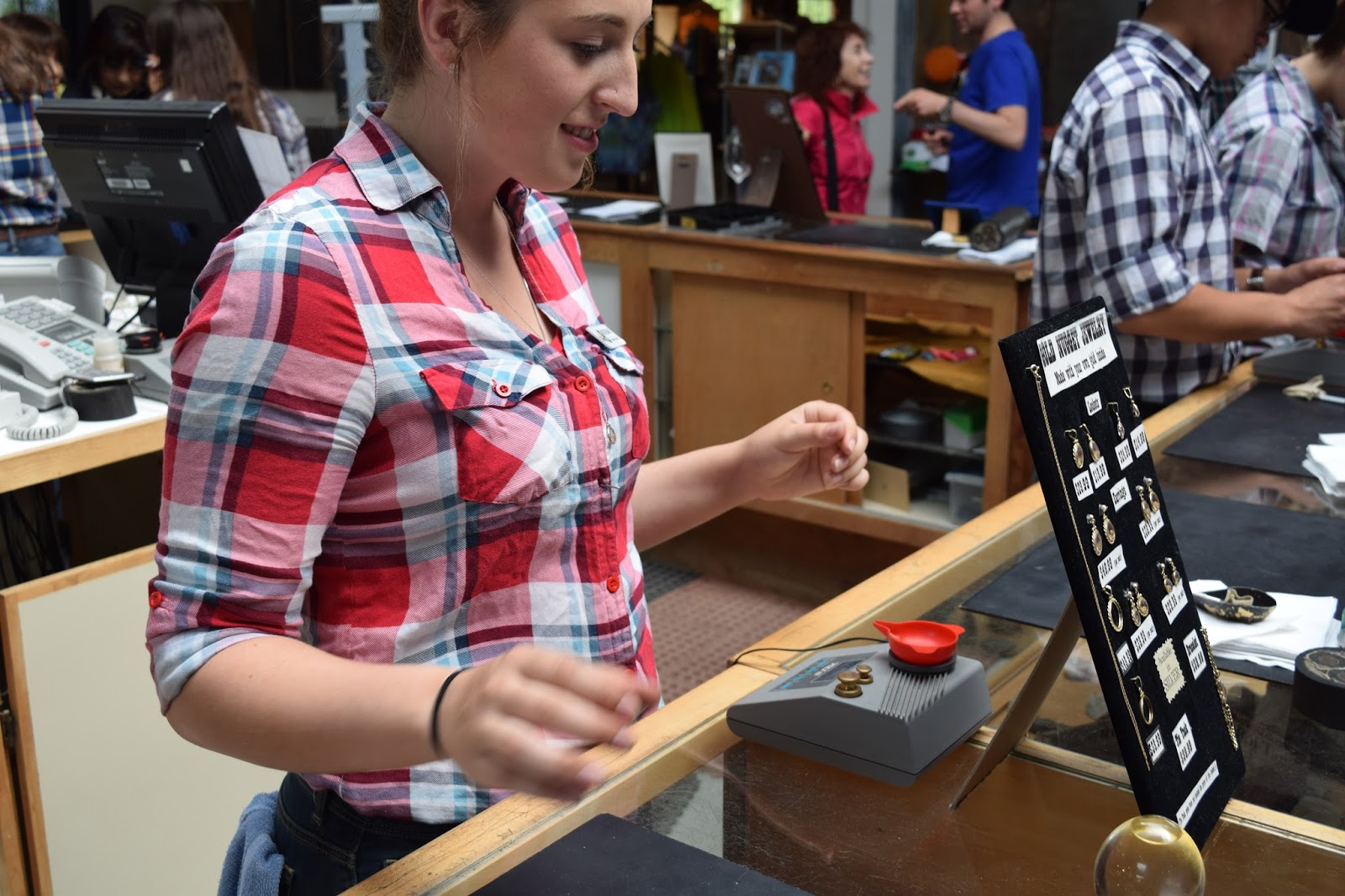
We got to pan for gold.  Cliff managed to find 4 little flakes.  I was laughing at his little flakes until the girl below weighed them, and said they were worth $18.00.  I told him to get his butt  back there and pan for more little flakes.


This is the woman that was telling us about the miners before.  Her necklace was one carat worth $1300.00.  She had 3 or 4 pretty good size nuggets in her pocket.  Quite a character, and loved telling about the dredge.

Employees at the dredge museum lining up to wave good by. Another great day.


2016 Aug Alaska 1

We crossed the Yukon at Dawson City and headed quickly up the "Top of the World Road" toward Chicken, Alaska. 
This fox was chasing me while I was waiting outside for the ferry. It must have been fed by humans before.  Scared me big time.  I'm sure I made someone laugh watching me jump into the coach.
We crossed on the ferry at 6:00 a.m. because we heard there were two caravans of RV's crossing that day (over 40 rigs).  Good thing we did, because it became a 6 hour wait.

Sunrise at the top of the world.  What a gorgeous day we had.  We talked to people who took this road the next day when it was rainy and foggy.  They missed all the beautiful scenery. 

These pictures don't do the view justice.  You could see hundreds of miles for 360 degrees.

The unimpressive border crossing into Alaska.  The woman Border Patrol asked us if we had any chocolate.  She was going to have to confiscate it if we did.  Funny woman.

The "Top of the World Road" has a reputation for being very rough.  It deserves this reputation.  RV's had to slow way down to pass each other.  No one lost a windshield, but we all had extra screens on our radiators and guards on our tow vehicles to prevent rocks from hitting the tows.


And this is basically all there is to Chicken, plus an RV park and a few remote houses.
This chicken lays golden eggs.

Part of our group enjoying breakfast. 


Another dredge tour in Chicken.  The Gold Rush left Dawson City area and moved all across Alaska in the early 1900's.  Above are the buckets used to scoop up the rock.  Each bucket weights 600 lbs empty. 
Above are bones dug up by the dredge, all prehistoric mammals.  The skull is from a Steppe Bison.
The sluice is where the fine rock is washed leaving behind the gold.  It's just amazing how this huge machinery worked and how it was engineered in the first place.


Above left is how man made sluices worked.  Above right, our group helping each other wash our rigs.  The road was so dusty, it was awful how dirty our RV's were.  Gail is trying to give everyone a shower.

So we reached the Northern end of the Alaskan Highway just south of Fairbanks.